🧠 Why This Matters
Flowers- when you actually place them in your environment – will prove to offer a deeper connection than just visual comfort.
Research has proven the healing benefits of flowers. They influence hormonal balance, regulate emotional reactivity, and support the nervous system’s ability to downshift. Participants in multiple clinical trials reported reduced fatigue, improved focus, and lowered stress after short-term exposure to fresh blooms.
Peer-reviewed studies confirm that flowers support emotional regulation and nervous system balance. In clinical settings, participants exposed to floral environments showed lower fatigue, improved focus, and reductions in stress-related symptoms (Park & Mattson, 2009; Chang & Chen, 2005; Ulrich et al., 1991). These findings aren’t limited to hospitals — similar effects have been observed in offices, classrooms, and home environments.
These effects don’t require long rituals or expensive tools. One visible stem, placed where your tension gathers, is often enough to change the tone of your day.
👩⚕️ Expert Insight
“Environmental cues shape mental performance. We see changes in heart rate, breath patterns, and self-regulation just by introducing organic forms like flowers,” says Dr. Rebecca Solton, psychiatrist and founder of Healing Environments.
“That kind of shift doesn’t rely on language or intention — it comes from repeated visual presence.”
Dr. Rebecca Solton’s scientific approach includes low-effort floral placements in therapeutic spaces, chosen for shape and color rather than fragrance or symbolism.
🌿 Ritual 1: Sink Bloom Pause
When: Before your first mental task
Why: Interrupts automatic behavior
You likely start your day in front of the mirror, barely thinking. Place a small bloom beside the faucet. This creates a soft marker — something that signals your day hasn’t begun without your awareness. Use a bud vase, a petal-patterned cloth, or a compact floral soap dish.
Mindful pick: Try this floral cleansing bar — lightly scented and designed for daily repetition.
🌼 Ritual 2: Desk-Edge Bloom
When: Before checking emails or opening tabs
Why: Protects your attention from fragmentation
Instead of glancing straight into screens, let your gaze meet a single flower first. Choose something with an irregular curve or subtle movement. This encourages a moment of orientation — a reset before stimulation.
Readers also liked: Matte ceramic bud vases that fit in compact corners or window ledges.
🌸 Ritual 3: The Pocket Anchor
When: On the go, during transitions
Why: Helps return to the body
Keep a soft item in your coat pocket or bag: a dried flower sachet, a fabric flower clip, even a petal-printed handkerchief. During commutes or spirals, touch it without needing to pause or explain. Familiar textures offer grounding — and with repetition, they become neurological shorthand for calm.
You might love: A linen botanical pouch that fits neatly in the palm of your hand.
🌺 Ritual 4: Steep and Sit
When: Mid-morning or after lunch
Why: Replaces passive scrolling with intentional pause
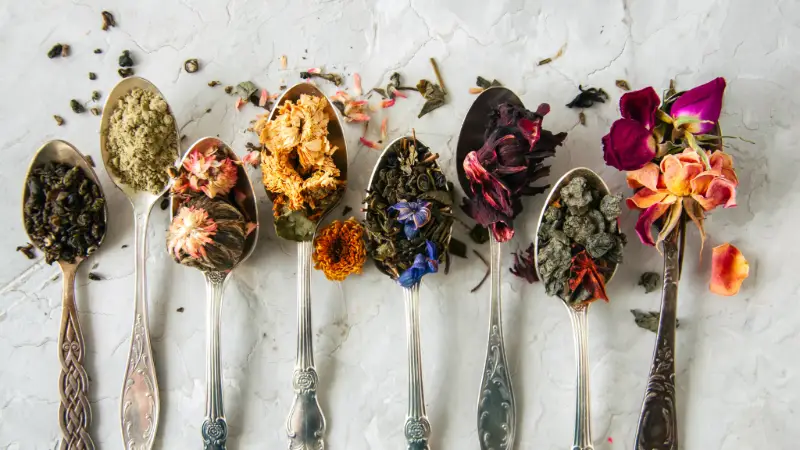
Choose a floral tea and a dedicated cup. Sit. Nothing else needs to happen. Lavender, hibiscus, or rose help regulate your breath and body temperature. Use a coaster or napkin with botanical print — even subtle visuals engage your brain’s ambient awareness system.
Mindful pick: This floral tea trio includes three calming blends and comes in box, that is individually packed.
🌷 Ritual 5: Mirror Petal
When: During self-checks or makeup routines
Why: Offers balance to critical self-talk
Tape a pressed flower beside your mirror — not for aesthetics, but as a pause point. You’ll see it every day, and over time, it may become a visual nudge away from judgment and toward neutrality. Swapping the flower weekly adds variety and helps register small seasonal changes.
Readers also loved: This pressed-flower sticker pack with fade-resistant finishes.
🪻 What Helps You Remember
Rituals don’t need to be remembered if the environment prompts them. These ideas help flowers become part of your daily flow:
- Stick a bloom magnet on your fridge handle
- Use a floral coaster under your glass
- Add a botanical decal to your laptop or phone case
- Drop a dried petal into the drawer you open most often
A small visual change in a frequently used space is enough to create a new response pattern — one that doesn’t require motivation to start working.
📚 Scientific Sources
- Harvard Gazette. “Healing Power of Plants and Flowers.” (2005)
- Ulrich, R.S. “View Through a Window May Influence Recovery.” Science (1984)
- Lohr, V. et al. “Interior Plants Improve Productivity and Reduce Stress.” Journal of Environmental Horticulture (2000)
- Solton, R. (2023). Healing Environments: Clinical Design in Mental Health Care